
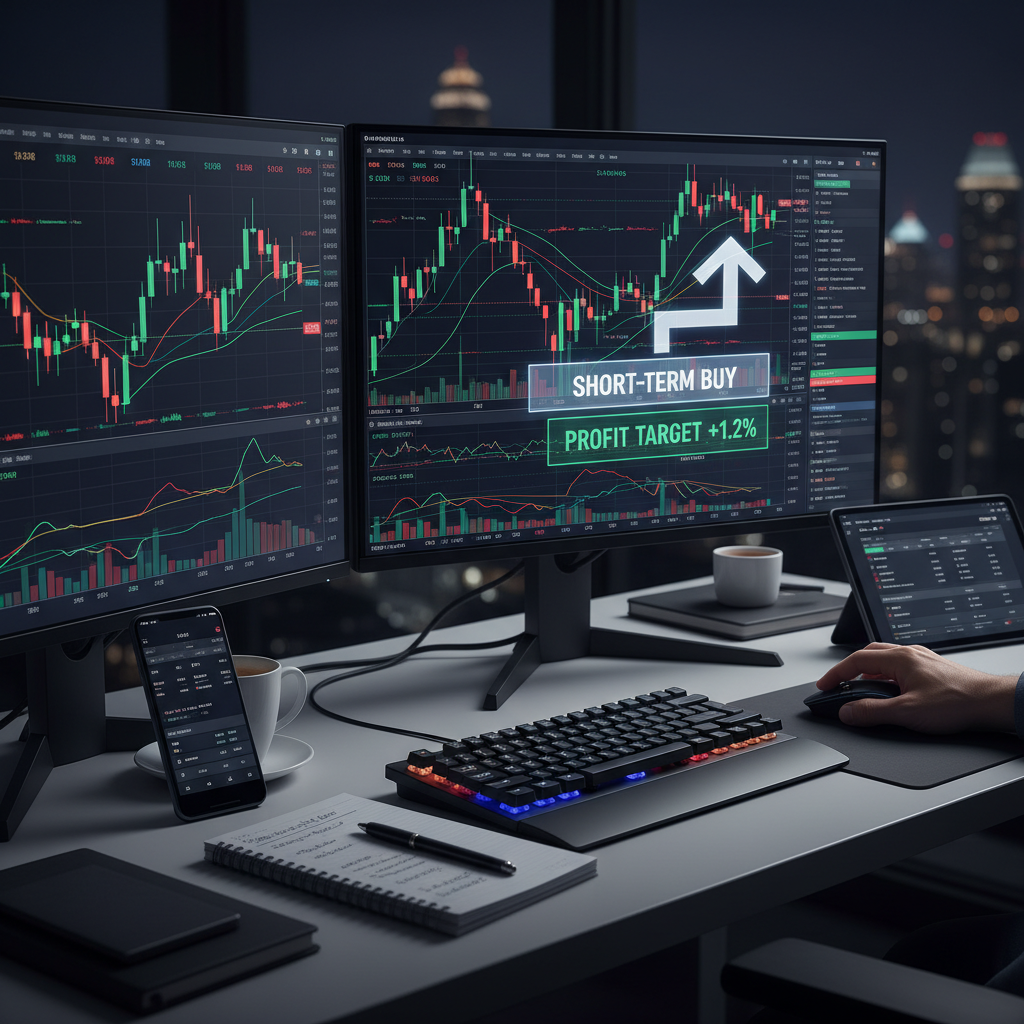
In the fast-paced world of financial markets, some seek the slow and steady growth of long-term investing, while others are drawn to the thrill and potential of rapid gains. If you fall into the latter category, you’ve likely heard of short-term trading. It’s a dynamic approach that focuses on profiting from market fluctuations over a brief period, from a few weeks down to mere seconds.
Table of Contents
- What is Short-Term Trading?
- Types of Short-Term Trading Styles
- Scalping
- Day Trading
- Swing Trading
- The Pros and Cons of Short-Term Trading
- The Advantages (Pros)
- The Disadvantages (Cons)
- Essential Strategies and Tools for Success
- Technical Analysis is Key
- Popular Technical Indicators
- Risk Management: The Trader’s Most Important Skill
- How to Get Started with Short-Term Trading: A 5-Step Guide
- Is Short-Term Trading Right for You?
But short-term trading is more than just buying low and selling high quickly. It’s a discipline that requires strategy, risk management, and a deep understanding of market psychology. This comprehensive guide will break down everything you need to know, from the core concepts to actionable strategies for getting started.
What is Short-Term Trading?
Short-term trading is the practice of buying and selling financial assets—like stocks, forex, or cryptocurrencies—with the intention of holding them for a short period. Unlike long-term investing, which relies on a company’s fundamental growth over years, short-term trading aims to capitalize on price volatility. Traders look for small, predictable movements and execute trades to capture profit from them.
This approach heavily relies on technical analysis, which involves studying price charts and market statistics to forecast future price movements. Fundamental analysis (looking at a company’s financial health) takes a backseat, as the focus is on immediate market sentiment and price action.
Types of Short-Term Trading Styles
The term “short-term” is broad. Several distinct styles fall under this umbrella, each with its own timeframe and intensity.
Scalping
Scalping is the fastest form of trading. Scalpers aim to skim tiny profits from a large number of trades throughout the day, often holding positions for just a few seconds to a few minutes. Success depends on precision, discipline, and low transaction costs.
- Timeframe: Seconds to minutes.
- Goal: Make small, consistent profits on dozens or hundreds of trades.
- Requires: Intense focus, quick decision-making, and access to a direct-access broker for fast execution.
Day Trading
As the name suggests, day traders open and close all their positions within a single trading day. They avoid holding any positions overnight, which insulates them from risk related to after-hours news or market-opening gaps. Day traders typically make a handful of trades per day, holding them for minutes to hours.
- Timeframe: Minutes to hours (within one day).
- Goal: Profit from intraday price swings.
- Requires: A significant time commitment during market hours and a solid understanding of intraday patterns.
Swing Trading
Swing trading is a slightly slower-paced strategy. Swing traders aim to capture larger market “swings” by holding positions for several days to a few weeks. This style allows traders to profit from trends that last longer than a single day but are shorter than a major long-term trend.
- Timeframe: A few days to several weeks.
- Goal: Capture a significant portion of a market move or trend.
- Requires: Less constant screen time than day trading but requires patience and the ability to identify developing trends.
The Pros and Cons of Short-Term Trading
Before diving in, it’s crucial to weigh the potential rewards against the inherent risks.
The Advantages (Pros)
- Potential for High Returns: The ability to compound gains quickly can lead to substantial returns in a short period.
- Reduced Overnight Risk: Day traders and scalpers are not exposed to risks from events that occur when the market is closed.
- Flexibility: Opportunities exist in both rising (going long) and falling (going short) markets.
- Active Engagement: It provides a hands-on, engaging way to interact with the financial markets.
The Disadvantages (Cons)
- High Risk: The potential for rapid, significant losses is just as real as the potential for gains.
- Stress and Emotion: The fast-paced nature can be emotionally draining. Fear and greed can lead to poor decisions.
- Significant Time Commitment: This is not a passive activity. It requires constant attention, research, and analysis.
- Transaction Costs: Frequent trading generates more commissions and fees, which can erode profits if not managed carefully.
Essential Strategies and Tools for Success
Successful short-term traders don’t rely on luck. They use a defined strategy and a set of analytical tools to gain an edge.
Technical Analysis is Key
Technical analysis is the bedrock of short-term trading. It’s the art of using historical price data to make educated guesses about future movements. Core components include:
- Chart Patterns: Identifying recurring patterns like “head and shoulders,” “triangles,” and “flags” that can signal a potential price move.
- Support and Resistance: These are price levels where a trend is likely to pause or reverse. Support is a price floor, while resistance is a price ceiling.
- Candlestick Charts: These charts provide a rich visual representation of price action, showing the open, high, low, and close price for a specific period.
Popular Technical Indicators
Indicators are mathematical calculations based on price and/or volume, used to confirm trends and identify trading signals.
- Moving Averages (MA): Smooth out price data to create a single flowing line, making it easier to identify the trend direction.
- Relative Strength Index (RSI): A momentum oscillator that measures the speed and change of price movements, helping to identify overbought or oversold conditions.
- Moving Average Convergence Divergence (MACD): A trend-following momentum indicator that shows the relationship between two moving averages of an asset’s price.
Risk Management: The Trader’s Most Important Skill
You can have the best strategy in the world, but without proper risk management, one bad trade can wipe out your account. This is non-negotiable.
- The 1% Rule: A common guideline is to never risk more than 1% of your total trading capital on a single trade.
- Set Stop-Loss Orders: This is an automatic order placed with your broker to sell an asset when it reaches a certain price. It’s your safety net against catastrophic losses.
- Use Take-Profit Orders: This order automatically closes your position when it reaches a specific profit target, ensuring you lock in gains.
- Understand Your Risk-to-Reward Ratio: Only take trades where the potential profit is significantly greater than the potential loss. A ratio of 2:1 or higher is often recommended.
How to Get Started with Short-Term Trading: A 5-Step Guide
Ready to take the first step? Follow this structured approach to begin your journey.
- Educate Yourself: Before risking a single dollar, immerse yourself in learning. Read books, take online courses, and watch videos from reputable traders.
- Choose a Market: Decide whether you want to trade stocks, forex, crypto, or commodities. It’s best to master one market before moving on to others.
- Develop a Trading Plan: Your plan is your rulebook. It should define which assets you’ll trade, your strategy for entry and exit, and your risk management rules. Write it down and stick to it.
- Practice with a Demo Account: Nearly all brokers offer a “paper trading” or demo account with virtual money. Use it to test your trading plan in real market conditions without any financial risk.
- Start Small: Once you are consistently profitable in your demo account, you can move to a live account. Start with a small amount of capital that you are fully prepared to lose. This will help you get used to the psychology of trading with real money.
Is Short-Term Trading Right for You?
Short-term trading offers an exciting path to financial growth, but it is not a get-rich-quick scheme. It is a serious business that demands discipline, continuous learning, emotional control, and a high tolerance for risk.
If you are willing to put in the time and effort to develop a robust strategy and manage your risk meticulously, short-term trading can be a highly rewarding endeavor. If not, the slow and steady path of long-term investing might be a better fit. The key is to be honest with yourself about your personality, your goals, and your capacity for risk.