
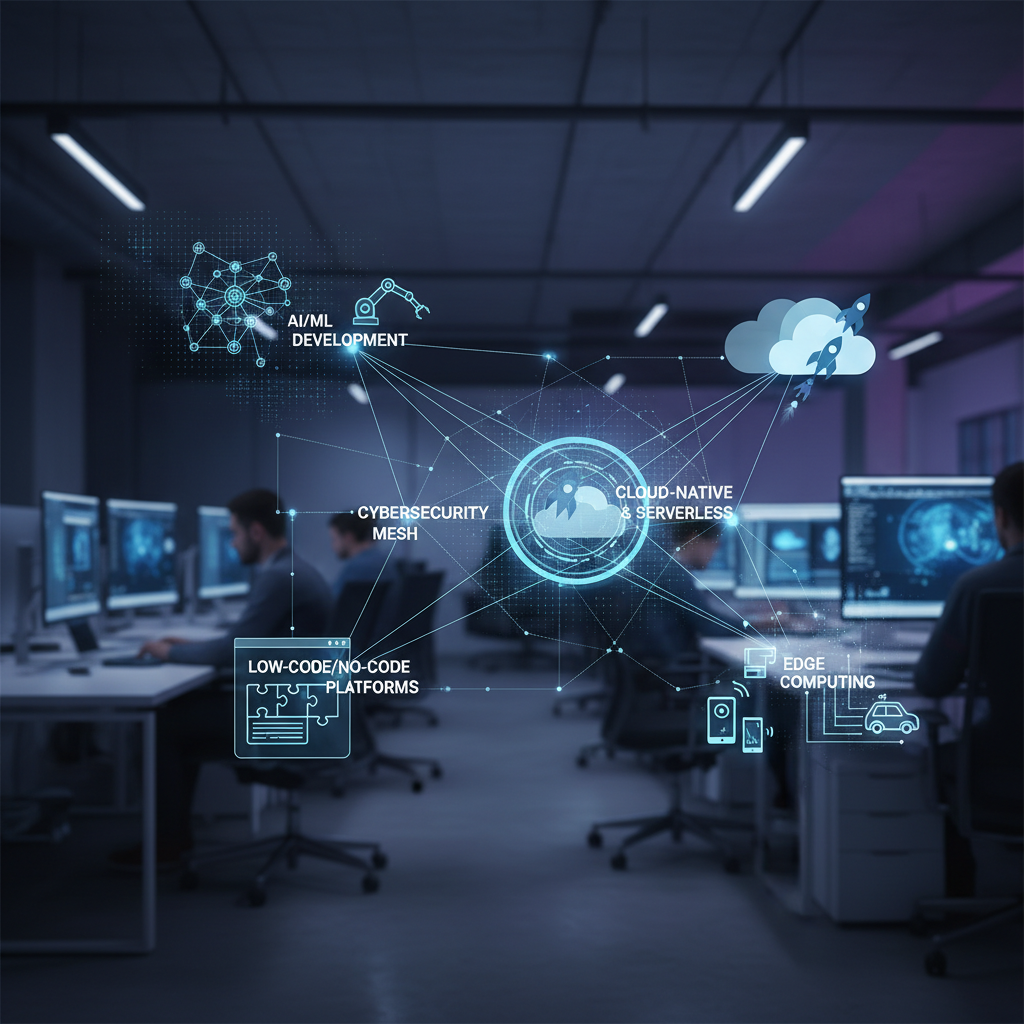
The world of software development moves at lightning speed. What was revolutionary yesterday is standard practice today, and what’s emerging now will define the applications of tomorrow. For developers, businesses, and tech enthusiasts, staying on top of these shifts isn’t just beneficial—it’s essential for survival and growth. From artificial intelligence co-piloting our coding to building applications with sustainability in mind, the landscape is more exciting than ever.
Table of Contents
- 1. Artificial Intelligence and Machine Learning are Everywhere
- AI-Powered Coding Assistants
- The Rise of MLOps
- 2. Low-Code/No-Code Platforms Democratize Development
- Why It’s a Game-Changer:
- 3. Cybersecurity is Everyone’s Job: The DevSecOps Movement
- Shifting Security Left
- 4. The Cloud Evolves: Cloud-Native and Serverless
- Building for the Cloud (Cloud-Native)
- Forgetting about Servers (Serverless)
- 5. Progressive Web Apps (PWAs): The Best of Web and Mobile
- 6. WebAssembly (Wasm): Unleashing Near-Native Speed in Browsers
- 7. Sustainable Software Engineering (Green Coding)
- Embracing the Future of Software Development
Ready to explore what’s next? We’ve compiled the most impactful software development trends that are shaping the industry right now and for years to come.
1. Artificial Intelligence and Machine Learning are Everywhere
AI is no longer a futuristic concept; it’s a practical tool integrated into the entire software development lifecycle (SDLC). This trend is transforming how we build, test, and deploy software.
AI-Powered Coding Assistants
Tools like GitHub Copilot and Tabnine are fundamentally changing the developer experience. These AI-powered assistants suggest code snippets, complete functions, and even help debug in real-time. They act as a “pair programmer,” boosting productivity, reducing repetitive tasks, and allowing developers to focus on complex problem-solving.
The Rise of MLOps
As more applications integrate machine learning models, managing them has become a major challenge. MLOps (Machine Learning Operations) applies DevOps principles to the machine learning workflow. It automates and streamlines the process of building, training, and deploying ML models, ensuring they are reliable, scalable, and efficient in production.
2. Low-Code/No-Code Platforms Democratize Development
The demand for new applications is far outpacing the supply of skilled developers. Low-Code/No-Code (LCNC) platforms are bridging this gap by empowering non-technical users (“citizen developers”) to build applications using visual, drag-and-drop interfaces.
Why It’s a Game-Changer:
- Speed: Drastically reduces development time from months to days.
- Accessibility: Allows business experts to build tools they need without writing a single line of code.
- Efficiency: Frees up professional developers to work on more complex, mission-critical projects.
LCNC isn’t replacing developers; it’s augmenting them and enabling faster innovation across organizations.
3. Cybersecurity is Everyone’s Job: The DevSecOps Movement
With cyber threats becoming more sophisticated, security can no longer be an afterthought. DevSecOps integrates security practices into every phase of the DevOps pipeline, from planning and coding to testing and deployment.
Shifting Security Left
The core principle of DevSecOps is to “shift left”—addressing security concerns as early as possible in the development process. This involves:
- Automated security scanning in CI/CD pipelines.
- Secure coding training for all developers.
- Threat modeling during the design phase.
By making security a shared responsibility, teams can build more resilient and secure applications from the ground up.
4. The Cloud Evolves: Cloud-Native and Serverless
Cloud computing continues to be a dominant force, but the way we use it is evolving. The focus has shifted from simply “lifting and shifting” applications to the cloud to building them specifically for the cloud environment.
Building for the Cloud (Cloud-Native)
Cloud-native architecture uses technologies like containers (Docker) and orchestration (Kubernetes) to build applications as a collection of independent microservices. This approach provides incredible scalability, resilience, and flexibility, allowing teams to update and deploy individual components without affecting the entire application.
Forgetting about Servers (Serverless)
Serverless computing, or Functions-as-a-Service (FaaS), takes abstraction a step further. Developers can write and deploy code without managing any underlying server infrastructure. Platforms like AWS Lambda and Azure Functions automatically handle scaling based on demand, and you only pay for the compute time you actually use, making it incredibly cost-effective for variable workloads.
5. Progressive Web Apps (PWAs): The Best of Web and Mobile
Why choose between a web app and a native mobile app when you can have the best of both? Progressive Web Apps (PWAs) are web applications that deliver an app-like experience to users. They are a powerful trend because they offer:
- Installable: Can be added to a user’s home screen, just like a native app.
- Offline Capability: Service workers allow PWAs to function even with a poor or no internet connection.
- Engagement: Capable of sending push notifications to re-engage users.
- Discoverability: They are discoverable by search engines and don’t require an app store for distribution.
6. WebAssembly (Wasm): Unleashing Near-Native Speed in Browsers
For decades, JavaScript has been the undisputed king of web development. WebAssembly is changing that. Wasm is a binary instruction format that serves as a compilation target for high-level languages like C++, Rust, and Go. This allows developers to run high-performance, computationally intensive applications—such as 3D games, video editors, and complex data visualizations—directly in the browser at near-native speeds.
7. Sustainable Software Engineering (Green Coding)
The tech industry has a significant carbon footprint, from massive data centers to power-hungry devices. Sustainable software engineering, or “Green Coding,” is an emerging trend focused on building applications that are more energy-efficient and environmentally friendly. This involves writing optimized code, choosing efficient infrastructure, and designing applications that minimize resource consumption, proving that high performance and sustainability can go hand-in-hand.
Embracing the Future of Software Development
The only constant in software development is change. The trends listed here—from the pervasive influence of AI to the growing importance of sustainability—highlight a move towards more intelligent, efficient, secure, and accessible development practices. For developers and organizations, embracing continuous learning and adapting to these new paradigms isn’t just an option; it’s the key to building the next generation of groundbreaking software.